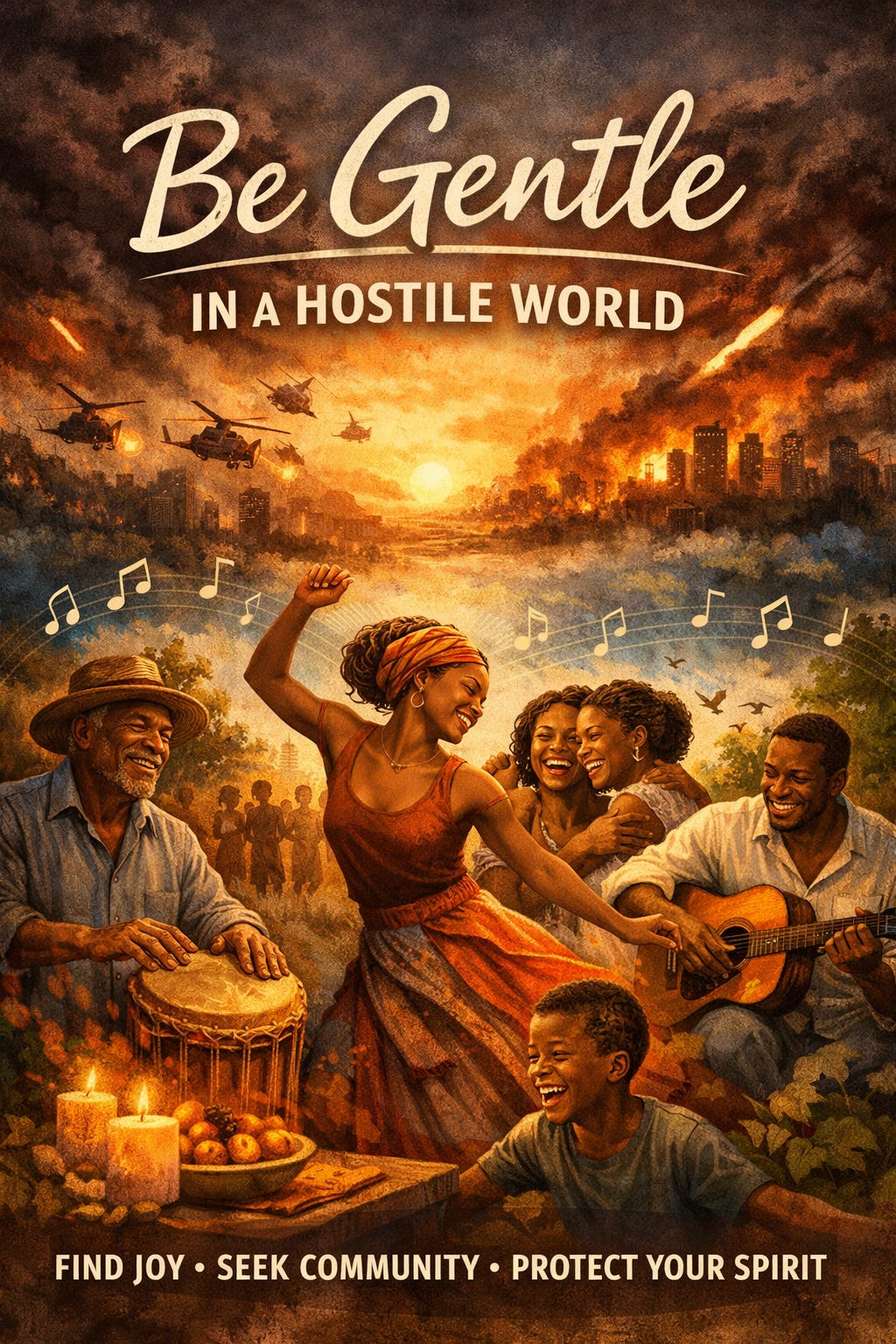
Be Gentle in a Hostile World
We are living in a hostile society.
Everywhere we turn there is aggression—wars broadcast in real time, leaders promising ultimate destruction, and an endless stream of crisis poured directly into our nervous systems through the small glowing screens we carry in our hands. The language of power has become the language of annihilation. Defense secretaries talk casually about wiping nations from existence while ordinary people are simply trying to wake up, take their children to school, go to work, pay the mortgage, and maybe—if they are lucky—find a moment of joy.
It is a surreal dissonance.
The people in charge of armies speak about the end of the world while the rest of us are packing lunches and answering emails.
This contradiction is not accidental. Hostility has become the atmosphere we live in. A low hum of threat that vibrates through every part of public life.
And yet, in the middle of it, we are still expected to function as if nothing is wrong.
Go to work.
Answer messages.
Smile politely.
Consume the news.
Repeat tomorrow.
But our bodies know the truth.
Our nervous systems were never designed to absorb this much chaos.
Many of us feel it physically: headaches, exhaustion, anxiety that arrives without explanation, the sense that something inside us is constantly bracing for impact. It is the quiet, grinding stress of living in a world that seems permanently on the edge of violence.
So we must learn something radical.
We must learn how to be gentle in a hostile world.
Not naive. Not disengaged.
Gentle.
Gentleness is not weakness. It is survival.
And our ancestors understood this deeply.
For centuries, enslaved Africans lived inside one of the most brutal systems humanity has ever constructed. Their lives were governed by violence, exploitation, and the constant threat of death. Families were separated. Languages were stripped away. Humanity itself was denied.
The society surrounding them was not just hostile—it was designed to destroy them.
And yet they persevered.
Not only through resistance and rebellion, though those existed too.
They persevered through culture.
Through music.
Through dance.
Through community.
Through joy that refused to die.
In the fields, in the cabins, in hidden gatherings under the cover of night, enslaved Africans created rhythms that carried memory across oceans. They sang spirituals that held both sorrow and coded hope. They moved their bodies in dances that kept ancestral traditions alive even when everything else had been taken.
They built community wherever they could—because community regulates the nervous system. Because laughter, shared meals, storytelling, and rhythm remind the body that it is still alive.
These were not trivial acts.
They were acts of psychological and spiritual resistance.
When you sing in the face of brutality, you are refusing to let the brutality define your inner world.
When you dance despite oppression, you are telling your nervous system that life is still present.
When you gather with others to laugh, cook, pray, and celebrate, you are reclaiming the part of yourself that systems of power try hardest to destroy.
Your humanity.
We know these lessons.
They are in our blood.
Yet modern society pushes us away from them.
Instead of rhythm, we have constant alerts.
Instead of community, we have isolation.
Instead of gathering, we have scrolling.
Instead of dancing, we have sitting in quiet exhaustion.
Meanwhile the world grows louder, more aggressive, more destabilizing.
The truth is that many of us are trying to live normal lives inside an abnormal reality.
And because of that, choosing yourself has become an act of resistance.
Choosing to protect your nervous system.
Choosing to limit how much hostility enters your mind each day.
Choosing moments of joy even when the world insists that joy is frivolous.
It is not frivolous.
Joy is medicine.
Your nervous system needs quiet. It needs laughter. It needs music. It needs sunlight and movement and connection with other human beings.
It needs the same things our ancestors instinctively created under far worse conditions.
They did not survive by consuming every piece of brutality surrounding them. They survived by creating spaces where life could continue.
So we must do the same.
Limit the disruption to your nervous system.
Turn off the news when it becomes a drumbeat of destruction.
Step outside and feel the sun.
Play music that moves your body.
Dance in your kitchen.
Call a friend.
Cook a meal that reminds you of home.
Sit in the presence of people who make you feel safe.
None of this ignores the world.
It prepares you to live in it.
Because a dysregulated, exhausted population is easier to control. A population cut off from joy, culture, and community loses the ability to imagine something better.
Our ancestors understood that preserving the spirit was essential to preserving the future.
And we must remember that now.
The world may be hostile.
But your inner world does not have to mirror it.
Choose gentleness.
Choose joy.
Choose community.
Choose to regulate your nervous system in a society that profits from dysregulation.
Choose the music.
Choose the dance.
Choose the people who remind you who you are.
The world may threaten destruction.
But life—real life—has always been built in the quiet, stubborn decision to keep living anyway.


