Empire, Currency, and the Bodies Left Behind
The pattern they don’t teach—and who always pays the price
We are taught that wars are about freedom.
That sanctions are about security.
That intervention is about human rights.
That framing is clean. Comfortable.
And largely untrue.
If you follow the money—more specifically, the currency—a different story emerges. One that is far less flattering, far more violent, and deeply consistent.
This isn’t conspiracy.
It’s financial history.
The pattern starts in Southeast Asia
This didn’t begin in the Middle East.
It began in Vietnam — and it did not stay there.
The Vietnam War is usually taught as a fight against communism, justified by the “domino theory.” But that explanation is deliberately incomplete.
After World War II, European colonial power was collapsing. France was losing its grip on Indochina, and with it access to land, labor, rubber, tin, rice, and strategic trade routes. The United States stepped in not to protect democracy, but to preserve Western economic dominance in a region asserting sovereignty.
By the 1960s, Vietnam represented something dangerous: proof that a formerly colonized nation could reject Western control and survive.
That threat could not be allowed to spread.
Between 1965 and 1973, the U.S. dropped more bombs on Vietnam than were dropped in all of World War II. The war cost the U.S. an estimated $168 billion at the time—over $1 trillion in today’s dollars—while defense contractors flourished.
But Vietnam wasn’t enough.
To prevent regional independence, the war expanded—quietly and illegally—into Cambodia and Laos.
Cambodia became one of the most heavily bombed countries in human history.
Laos remains the most bombed country per capita—with more than 80 million unexploded U.S. munitions still contaminating land today.
Children still lose limbs.
Farmers still can’t safely work their fields.
Millions of civilians were killed.
Entire societies destabilized.
Generations poisoned by Agent Orange.
Vietnam, Cambodia, and Laos were not anomalies.
They were the blueprint.
A blueprint where sovereignty is framed as ideological threat, economic independence is labeled extremism, and war is sold as prevention—while the costs are absorbed by Black and brown bodies abroad and poor bodies at home.
Once this model proved workable, it didn’t stop.
It evolved.
From bombs to balance sheets
After Vietnam, the U.S. learned something critical: direct occupation is expensive; economic control is cheaper.
In 1971, Richard Nixon took the U.S. dollar off the gold standard. Overnight, the dollar stopped being backed by gold and became backed by trust.
By all historical logic, it should have collapsed.
It didn’t.
Because three years later, Henry Kissinger brokered a deal with Saudi Arabia: oil would be sold only in U.S. dollars, and in exchange, the U.S. military would guarantee the regime’s security.
This was the birth of the petrodollar system.
From that moment on, every country on Earth needed dollars to buy energy.
That wasn’t free-market capitalism.
That was force-backed monetary policy.
What happens when countries resist
The response is consistent.
In 2000, Iraq announced it would sell oil in euros.
Three years later, the U.S. invaded.
No weapons of mass destruction were found.
Iraqi oil returned to dollars.
In 2009, Libya proposed a gold-backed African currency.
In 2011, NATO intervened for “humanitarian reasons.”
Muammar Gaddafi was killed.
The gold dinar disappeared.
Libyan oil went back to dollars.
Different continents.
Same outcome.
Why Venezuela was always next
If you’re wondering why Venezuela keeps appearing in U.S. foreign-policy headlines, the answer is simple.
Venezuela holds the largest proven oil reserves on Earth—even larger than Saudi Arabia’s.
But oil alone isn’t the issue.
Control is.
For decades, Venezuela attempted to assert sovereignty over its resources—nationalizing oil production, limiting U.S. corporate access, and openly challenging Western financial dominance. Under Hugo Chávez and later Nicolás Maduro, Venezuela pushed for regional independence and strengthened ties with China, Russia, and other non-Western blocs.
That made Venezuela dangerous.
Not because of socialism.
Not because of democracy.
But because of precedent.
A resource-rich Latin American country asserting control over its oil, questioning dollar dominance, and refusing U.S. political influence threatens the same system Iraq and Libya did—just closer to home.
So the familiar tools came out.
Sanctions first.
Crippling sanctions that:
Blocked access to global financial markets
Froze billions in state assets
Prevented oil revenue from being freely used
Directly contributed to shortages of food, medicine, and infrastructure repair
Sanctions that did not “pressure leadership”—they collapsed civilian life.
Then came political interference.
An opposition leader was declared president by the U.S. and allies without an election.
Assets were seized.
Diplomatic isolation intensified.
When that didn’t work, the narrative shifted.
Venezuela wasn’t just a struggling country anymore—it was a security threat.
“Humanitarian concern” became justification for intervention.
But the quiet truth remains:
Venezuela’s crime was not mismanagement alone.
Its crime was refusing to fully submit to U.S. economic control over the world’s most valuable resource.
The human cost
Behind every “currency stabilization effort” is a body.
Behind every sanction is a child.
Behind every intervention is a community erased.
This system is built on Black and brown bodies.
Iraq.
Libya.
Vietnam.
Cambodia.
Laos.
Venezuela.
Haiti.
Congo.
Palestine.
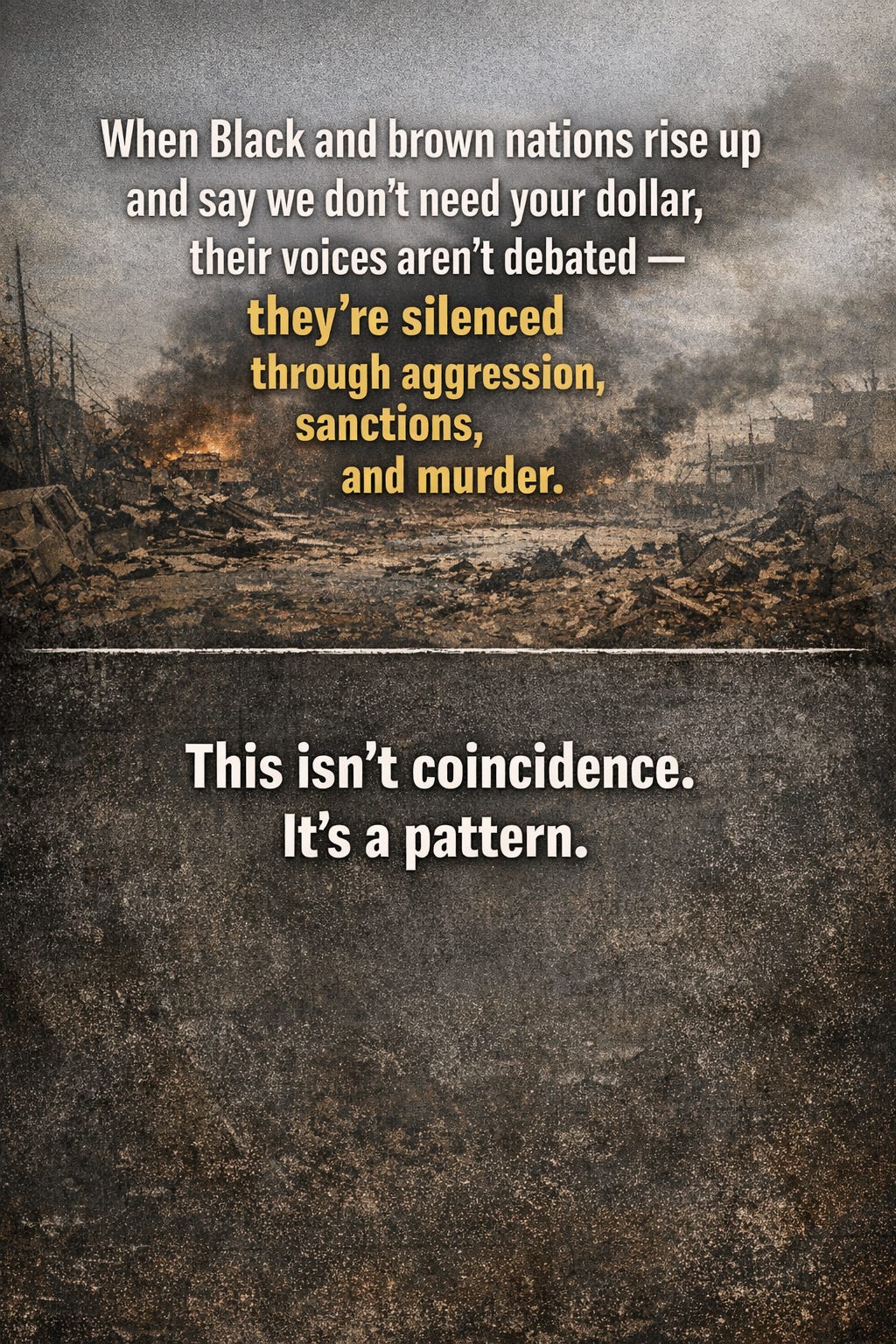
When Black and brown nations rise up and say we don’t need your dollar, their voices aren’t debated.
They’re silenced.
Through sanctions.
Through coups.
Through war.
Through assassination.
Aggression reframed as policy.
Murder dressed up as stability.
And at home?
It’s veterans with PTSD.
Families handed folded flags.
Defense contractors reporting record profits.
Wars don’t happen on spreadsheets.
Sanctions don’t hurt governments first.
They hurt civilians.
Always.
Late-stage empire
The Dutch guilder fell.
The British pound fell.
Now the U.S. dollar strains under debt, overreach, and rising alternatives.
Investor Ray Dalio has outlined this clearly: late-stage empires show rising debt, military overextension, currency pressure, and rivals building exit routes.
China’s Belt and Road Initiative is not charity.
BRICS is not symbolic.
They are escape hatches from dollar dependence.
When reserve status erodes—not if, when—the ability to print money without consequence disappears. Military reach contracts. Empire follows.
The lie we keep telling
We don’t send people to die for freedom and democracy.
That’s the branding.
The policy language talks about “maintaining dollar liquidity in global energy markets.”
Currency funds the military.
The military protects the currency.
That’s how empire works.
I’m not anti-military.
I’m anti-bullshit.
If we’re going to keep sending people to fight—
If we’re going to keep crushing Black and brown nations to maintain dominance—
Then the least we owe the dead and the living is honesty.
Empire isn’t measured only in power or profit.
It’s measured in the bodies it leaves behind.
And once you see the pattern, you can’t unsee it.


