

The Caribbean tells one story—just in different accents.
From Haiti to Jamaica, from Barbados to Cuba, from Trinidad to Puerto Rico, from the Dominican Republic to The Bahamas—and for me, from Grenada, home—the timelines shift, the flags change, but the pattern remains the same:
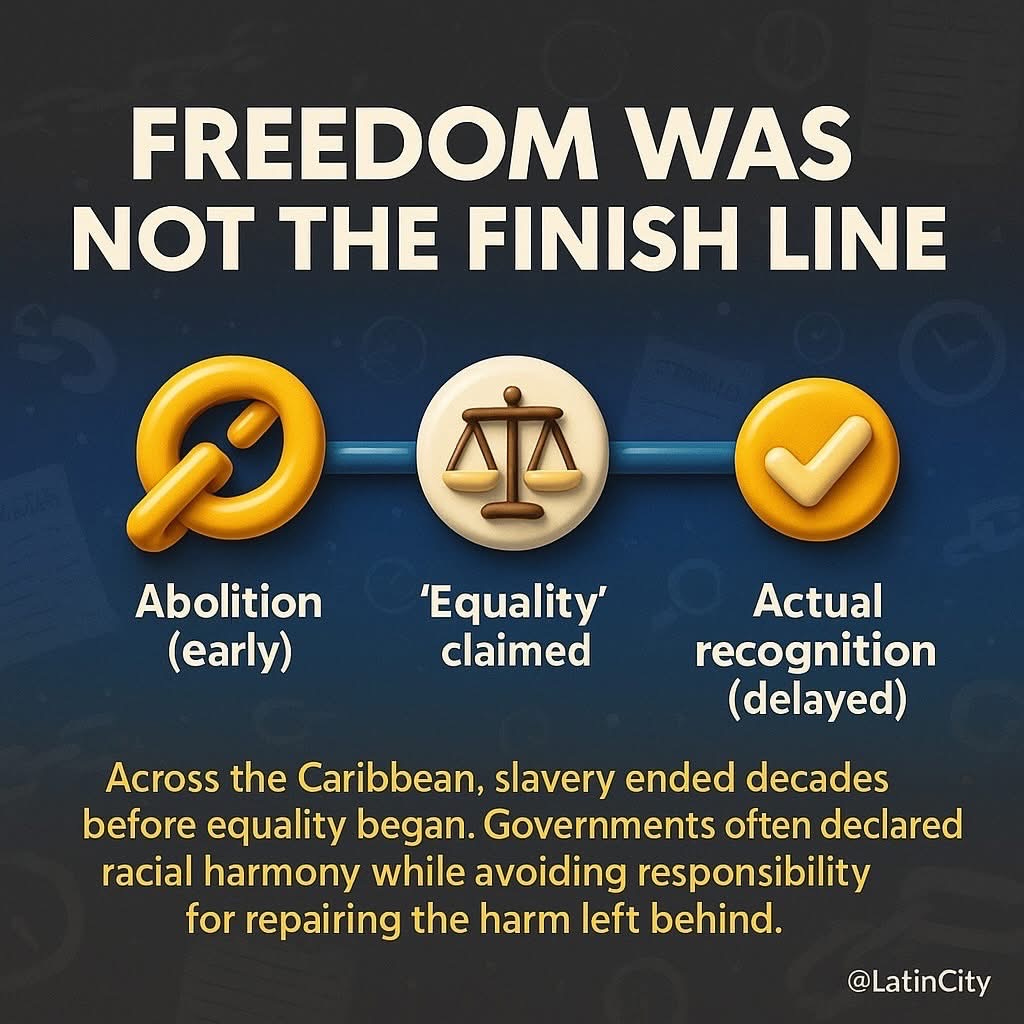
Slavery ended.
But power did not transfer.
Freedom was declared.
But justice was deferred.
And if we’re honest, this story does not stop at the shoreline.
The Diaspora Is Not Separate—It Is Continuous
What happened in the Caribbean did not stay in the Caribbean.
It moved.
It lives in the United States.
It lives in Latin America.
It lives in Europe.
It lives anywhere our people were taken, scattered, or forced to rebuild.
The African diaspora is not a collection of disconnected experiences—it is a single, continuous story shaped by displacement, resistance, and survival.
The same systems that denied land in Jamaica created sharecropping in the American South.
The same racial hierarchies in the Dominican Republic show up in anti-Blackness across Latin America.
The same economic isolation imposed on Haiti echoes in how Black nations and communities are treated globally.
Different geography.
Same design.
We are connected not just by ancestry—but by structure.
And that’s what people miss when they try to isolate our struggles.
Grenada: A Small Island, A Global Story
When I speak about this, I speak from Grenada—not just as a place, but as a point in that larger map.
Grenada’s history—colonization, revolution, intervention—is not unique. It is part of a broader pattern of what happens when Black people move toward self-determination.
There is always a response.
There is always a recalibration.
There is always an effort to contain what cannot be controlled.
And that pattern does not end at borders.
Haiti Was the Blueprint—and the Warning
Haiti showed the world what was possible.
A successful revolution.
A free Black republic.
A declaration that slavery could be dismantled completely—not negotiated, not softened, but ended.
And for that, Haiti was punished.
Not just in that moment—but for generations.
Because Haiti disrupted the global order.
And the global order responded.
That response did not stay in Haiti.
It became policy.
It became precedent.
It became the quiet understanding that Black freedom—real freedom—would always be met with resistance.
Cuba and the Continuation of Control