

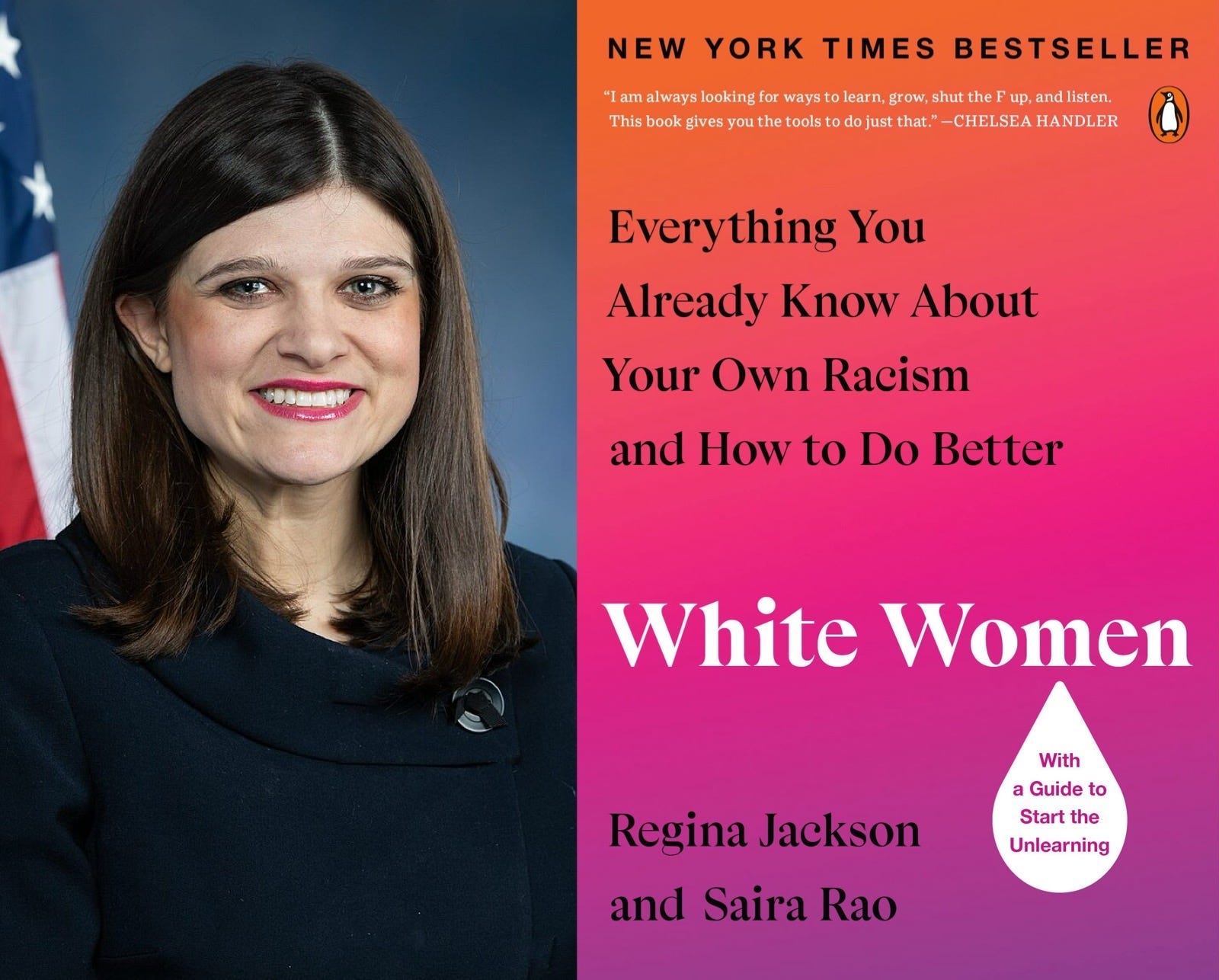
I saw the news about Haley Stevens endorsing Republican Mike Rogers over Abdul El-Sayed, the Democratic nominee who defeated her in Michigan’s Senate primary.
And I wasn’t surprised.
Not even a little bit.
I imagine there are plenty of Black women across America who saw that news, shook their heads, and kept scrolling. Because if you’ve spent any meaningful amount of time navigating spaces dominated by white women, particularly spaces where power, privilege, and accountability intersect, you’ve seen some version of this before.
The tears. The indignation. The sudden transformation from ally to victim when things don’t go their way.
And then the betrayal.
We are expected to be shocked every time. To treat each incident as an isolated lapse in judgment rather than part of a historical pattern.
But I am tired of pretending that history isn’t standing right in front of us.
When White Womanhood Meets Power
On November 1, 2026, Haley Stevens, a Democratic congresswoman who lost Michigan’s Senate primary to Abdul El-Sayed, publicly endorsed his Republican opponent, Mike Rogers.
The Associated Press reported that Stevens had previously pledged to support El-Sayed and had reaffirmed that position just days before changing course.
El-Sayed is a Muslim American candidate who has challenged American support for Israel’s military campaign in Gaza.
Stevens has been a staunch supporter of Israel. Their relationship deteriorated over an advertisement produced by an outside political group criticizing American support for Israel. Stevens called the advertisement antisemitic. El-Sayed said his campaign had not produced it and that he disagreed with its content.
Stevens said she had been excluded from a planned unity event. Then she endorsed Rogers.
A Republican supported by Donald Trump.
The same Trump whose policies she had publicly opposed.
According to The Guardian’s November 1 reporting, Trump praised her decision and invited her to join the Republican Party.
Her former chief of staff and other members of her team publicly broke with her decision.
What I see is a familiar political contradiction.
A woman who opposed Trump’s agenda chose to endorse a man aligned with it rather than the Democratic nominee who defeated her.
Stevens has offered her explanation. I am not claiming to know her private motivations.
But her public decision raises a legitimate question about what happens to political solidarity when the person expected to lead is no longer the person holding power.
Let’s Talk About the Money. And the Bodies.
The Michigan Senate primary also attracted extraordinary spending from outside political organizations, including groups aligned with AIPAC, which supported Stevens.
That spending matters because it reveals how deeply American foreign policy interests can shape domestic elections.
And it brings me to a question I cannot ignore.
What exactly are we defending when we defend unconditional American military support for Israel?
The United States provides Israel with billions of dollars in military assistance. American-made weapons have been used in Gaza, where Palestinian civilians have endured mass death, displacement, hunger, and destruction.
Human rights organizations, including Amnesty International, have concluded that Israel’s actions constitute genocide. Israel disputes that conclusion, and the legal proceedings and debates surrounding the characterization are consequential.
But no legal debate should make the suffering of Palestinian civilians invisible.
We provide money.
We provide weapons.
We provide diplomatic support.
And then we discuss humanitarian suffering as though American policy exists separately from the destruction.
It does not.
I have a fundamental problem with politicians defending continued military assistance while presenting humanitarian relief as sufficient evidence of compassion.
Palestinian women are women.
Palestinian children are children.
Their lives do not become less valuable because acknowledging their suffering complicates American political alliances.
And when political leaders ask us to distinguish their intentions from the consequences of their policies, I believe the consequences deserve just as much attention.
White Women’s Betrayal Is Not New. It Is American History.
Let’s go back.
Because the relationship between white womanhood and white supremacy did not begin with Donald Trump, and it certainly did not begin with Haley Stevens.
Consider the women’s suffrage movement.
We are taught a sanitized version of the story: courageous women in white dresses marching for equality, demanding the right to vote, refusing to accept second-class citizenship.
And yes, women fought courageously for the vote.
But whose equality were they fighting for?
Some prominent white suffragists were willing to accommodate racism and marginalize Black women to advance their political goals.
During the 1913 Woman Suffrage Procession in Washington, DC, Black women faced pressure to march separately.
Ida B. Wells refused to accept that arrangement.
She insisted on marching with the Illinois delegation rather than accepting segregation within a movement supposedly dedicated to equality.
The National Women’s History Museum’s biography of Ida B. Wells documents her activism for both voting rights and racial justice.
Imagine demanding freedom for yourself while asking another woman to accept segregation so you can obtain it.
That is not solidarity.
That is a negotiation over whose humanity matters.
The Nineteenth Amendment, ratified in 1920, prohibited denying voting rights on the basis of sex. But Black women, particularly in the South, continued to face racist voter suppression for decades.
The constitutional victory did not create equal access to the ballot for everyone.
And that distinction matters.
And Let’s Not Forget Who Benefited From Affirmative Action
Since we’re talking about history, let’s discuss one of the most conveniently forgotten aspects of American conversations about race and opportunity.
White women have been among the major beneficiaries of affirmative action.
Yes. White women.
Not just the Black woman someone imagines took an undeserved position.
Not just the Black college student accused of stealing a seat from a supposedly more qualified white applicant.
White women.
And the history of how that happened is particularly revealing.
In 1964, Congress debated the Civil Rights Act, legislation born out of generations of Black resistance, organizing, sacrifice, and bloodshed.
During the debate, Congressman Howard W. Smith of Virginia, a segregationist who opposed civil rights legislation, introduced an amendment adding sex as a protected category under Title VII.
According to the National Archives, the amendment was likely intended to defeat the legislation.
Think about that.
A segregationist opponent of racial equality introduced language protecting women from employment discrimination, potentially hoping it would derail a landmark civil rights bill.
Instead, the legislation passed.
And in 1967, President Lyndon Johnson issued Executive Order 11375, expressly including sex in federal equal-employment and affirmative-action requirements.
Women became beneficiaries of an expanded framework for employment opportunity.
And white women benefited significantly.
Research and historical employment data document substantial occupational gains for white women during the affirmative-action era. Those gains were also shaped by expanded education, changing labor markets, and broader shifts in women’s employment.
It would be inaccurate to credit every advancement to affirmative action alone, or to claim that every affirmative-action program primarily benefited white women.
But their inclusion in the history of affirmative action is undeniable.
And that is what fascinates me about the American narrative.
A framework developed during the struggle against racial discrimination helped create opportunities for millions of women, including white women.
Yet affirmative action was repeatedly portrayed in public debate as an unfair advantage for Black people.
We became the face of supposedly undeserved opportunity while white women were advancing in workplaces and professions that had historically excluded them.
Think about corporate America.
Think about women entering management, human resources, law, medicine, finance, and executive leadership.
Think about how often diversity initiatives were celebrated as progress for women, even when the women advancing into leadership were predominantly white.
And then consider how frequently Black women remained underrepresented in those same spaces.
This is why I refuse to discuss feminism without discussing race.
Because the category of “women” has never guaranteed that all women benefit equally.
A white woman can experience sexism and still benefit from racism.
She can encounter a glass ceiling while standing on a floor that Black women have struggled to reach.
She can benefit from civil rights protections while opposing other policies intended to address racial inequality.
And she can believe she earned every opportunity entirely on her own while overlooking the legal and institutional changes that helped make those opportunities possible.
That is the contradiction I want us to confront.
Black Americans fought, marched, organized, were jailed, and died in pursuit of equal rights.
The resulting legal framework created opportunities far beyond Black communities.
That expansion was a good thing. Equality should benefit everyone.
But benefiting from a struggle and standing in solidarity with the people who led it are not the same thing.
And when I examine the history of white women’s political choices, I keep returning to the same question.
What happens when people benefit from movements for equality but do not consistently support extending that equality to others?
White Women’s Tears Have Never Been Harmless
Now let’s talk about something even more uncomfortable.
The historical power of white women’s accusations against Black men.
We cannot discuss white womanhood and white supremacy without acknowledging how claims of white female vulnerability have been used to justify racial terror.
In 1955, fourteen-year-old Emmett Till was brutally murdered in Mississippi after Carolyn Bryant accused him of inappropriate behavior toward her.
He was a child.
His killers used that accusation as a pretext for kidnapping, torturing, and murdering him.
For decades, questions surrounding Bryant’s account exposed the grotesque imbalance between whose words were believed and whose lives were disposable.
And Emmett Till was not an isolated case.
In 1921, an allegation involving white elevator operator Sarah Page and Black teenager Dick Rowland helped ignite the racial violence that culminated in the Tulsa Race Massacre.
The allegation was never established as a crime.
A prosperous Black community was devastated. Black people were killed. Homes and businesses were destroyed.
Long before either event, Ida B. Wells documented how accusations involving white women were used to rationalize lynchings, often concealing motives of racial domination, economic competition, and terror.
I am not arguing that every white woman’s accusation was false. Nor am I suggesting women should not be believed when reporting harm.
I am saying that American society created a racial hierarchy in which white women’s perceived innocence could be weaponized against Black people’s lives.
That power was real.
And the consequences were deadly.
The image of the endangered white woman became a justification for protecting white supremacy.
A woman’s alleged vulnerability could become the excuse for a Black man’s death.
That history matters because the language of victimhood has never existed separately from power.
Sometimes the person presenting herself as the victim is also benefiting from an unequal system.
And Then They Voted for Trump. Again. And Again.
We need to stop pretending Donald Trump’s political success is exclusively a story about angry white men.
White women helped elect him.
Election-night exit polls showed majorities of white women voters supporting Trump in 2016, 2020, and 2024.
More comprehensive analyses, including validated-voter studies from the Pew Research Center, have produced somewhat different estimates. In particular, Pew’s validated data do not establish a white female Trump majority in every one of those elections.
But the broader pattern is unmistakable: Trump has repeatedly received substantial support from white women, including a majority in 2024 according to Pew’s validated-voter analysis.
And that deserves examination.
Now, before someone rushes into the comments to tell me that not all white women voted for him, I know.
I know there are white women who organize, protest, challenge racism, defend reproductive freedom, and put their bodies and careers on the line for justice.
They exist. Their work matters.
But individual exceptions do not erase collective voting patterns.
And I refuse to participate in another conversation that demands we center the feelings of white women rather than examine the consequences of political choices.
Trump did not hide his rhetoric about immigrants, his treatment of women, or his attacks on democratic institutions.
Those positions were visible.
So were the consequences of his judicial appointments for reproductive rights.
Yet millions of white women supported him.
For me, that raises an uncomfortable question about the relationship between gender solidarity, racial identity, and political power.
It is a question worth examining rather than dismissing.
The Comfort of Being Close to Power
There is a particular kind of political bargain that America has repeatedly offered white women.
You may not hold the highest position in the hierarchy, but you can still benefit from proximity to those who do.
You can be denied certain privileges because you are a woman while simultaneously enjoying privileges because you are white.
And when those identities come into conflict, there is a choice to make.
Challenge the hierarchy entirely.
Or negotiate for a better position within it.
This is what I mean when I describe Haley Stevens’s decision as male-centered.
I am not suggesting that women cannot independently hold conservative or pro-Israel political beliefs.
Of course they can.
I am questioning why a woman who publicly opposed Trump’s agenda would choose to endorse a Republican aligned with that agenda after losing to the Democratic nominee.
Why did political disagreement become a reason to cross party lines?
Why did a Republican man become an acceptable alternative?
And what does that choice reveal about the limits of political solidarity?
These are questions about her public actions, not claims about private intentions.
To me, proximity to power is not the same thing as liberation.
Sometimes it is simply the preservation of an existing political arrangement.
Black Women Have Seen This Before
Black women know what it means to be invited into spaces where our labor is welcomed but our leadership is resisted.
We know what it means to be called upon to organize, mentor, educate, campaign, donate, and hold everything together.
We know what it means to be celebrated for our resilience until we challenge someone else’s authority.
And we know how quickly the language of sisterhood can disappear when accountability enters the room.
This happens in politics.
It happens in corporate America.
It happens in nonprofit organizations, educational institutions, activist movements, and spaces that publicly celebrate diversity while privately resisting meaningful redistribution of power.
I have spent enough time in professional and leadership environments to understand that inclusion and solidarity are not the same thing.
Being invited to the table does not mean someone is prepared to share power.
And being called an ally means very little if that alliance collapses when the outcome no longer serves you.
I do not need another performative declaration about women supporting women.
I need to see what happens when someone else has an opportunity you wanted.
I need to see what happens when justice requires sacrifice.
Because solidarity without sacrifice is often just branding.
And Yes, I Blame Them.
I hold white women who have participated in sustaining white supremacy accountable for their choices.
I hold suffragists who marginalized Black women accountable for the exclusions they accepted.
I hold those who made false accusations, participated in racial terror, or knowingly enabled it accountable for the destruction that followed.
And I hold voters responsible for the political consequences of their votes, including those who repeatedly supported Trump.
I also hold Haley Stevens accountable for the decision to endorse a Trump-backed Republican after losing a Democratic primary.
This is not an indictment of every white woman who has ever lived.
It is an examination of a documented history and the choices people continue to make within it.
I am not interested in assigning inherited guilt.
I am interested in present-day responsibility.
There is a difference.
And when I look at what is happening in Gaza, I cannot separate that responsibility from the broader question of whose suffering Americans are willing to tolerate.
Palestinian women are women.
Palestinian children are children.
Their lives are not less valuable because acknowledging their humanity complicates someone’s political alliances.
A feminism that cannot extend beyond whiteness, nationality, or geopolitical convenience is incomplete.
And a commitment to human rights that disappears when the people suffering are politically inconvenient deserves scrutiny.
Stop Asking Black Women to Be Surprised
What happened with Haley Stevens is not shocking to me.
It is disappointing.
It is politically consequential.
And it deserves scrutiny.
But shocking?
No.
The United States has a long history of people choosing the preservation of their own status over the liberation of others.
White women have been both victims of patriarchal systems and participants in maintaining racial hierarchies.
Both things can be true.
The existence of sexism does not absolve someone of racism.
The experience of marginalization does not automatically produce solidarity.
And being a woman does not make someone’s politics inherently compassionate, progressive, or just.
We need to stop confusing representation with liberation.
A woman in power can still uphold oppressive systems.
A woman can speak the language of equality while supporting policies that deny other people their humanity.
And a woman can call herself a Democrat while making a political choice that supports Donald Trump’s preferred candidate.
Haley Stevens’s endorsement demonstrates that final possibility.
So What Do We Do With This History?
I do not want this to become another moment of outrage that disappears when the next headline arrives.
I want us to examine the structures beneath the headlines.
Read the history of the suffrage movement beyond the sanitized versions taught in school.
Learn how civil rights legislation and affirmative action expanded opportunities, including for people who were not always willing to acknowledge the movements that made those opportunities possible.
Examine campaign finance and the influence of outside political spending.
Ask elected officials specific questions about military assistance, civilian protection, and accountability for human rights violations.
And most importantly, stop measuring solidarity by what people say when nothing is at stake.
Measure it by what they do when standing for someone else’s rights requires them to surrender comfort, influence, or access.
If this essay resonates with you, I invite you to do three things:
Read and share the history. Start with the National Archives’ account of women and the Civil Rights Act and the National Women’s History Museum’s biography of Ida B. Wells. Our understanding of the present becomes clearer when we stop erasing the past.
Educate Others. White Women: Everything You Already Know About Your Own Racism and How to Do Better
Demand transparency and accountability. Visit OpenSecrets to examine political contributions and outside spending. Use Congress.gov to review legislation and voting records. Contact your representatives through the U.S. House of Representatives and ask where they stand on military assistance, civilian protection, and human rights.
Have the uncomfortable conversation. In your workplace, your community, and your relationships, ask who benefits from policies intended to advance equality, who remains excluded, and who is expected to carry the burden of fighting for change.
We cannot undo history.
But we can stop pretending we don’t recognize its patterns.
Haley Stevens did not surprise me.
What would surprise me is watching more people choose justice when it costs them something.
And until that happens, I am done pretending these betrayals are unexpected.
If this piece made you uncomfortable, I hope you will sit with that discomfort long enough to ask why. If it gave language to something you have experienced, I invite you to share your perspective in the comments.
https://youtube.com/shorts/q0u4JqcheCI?is=0lxS9Ou5LsaN-7TK